
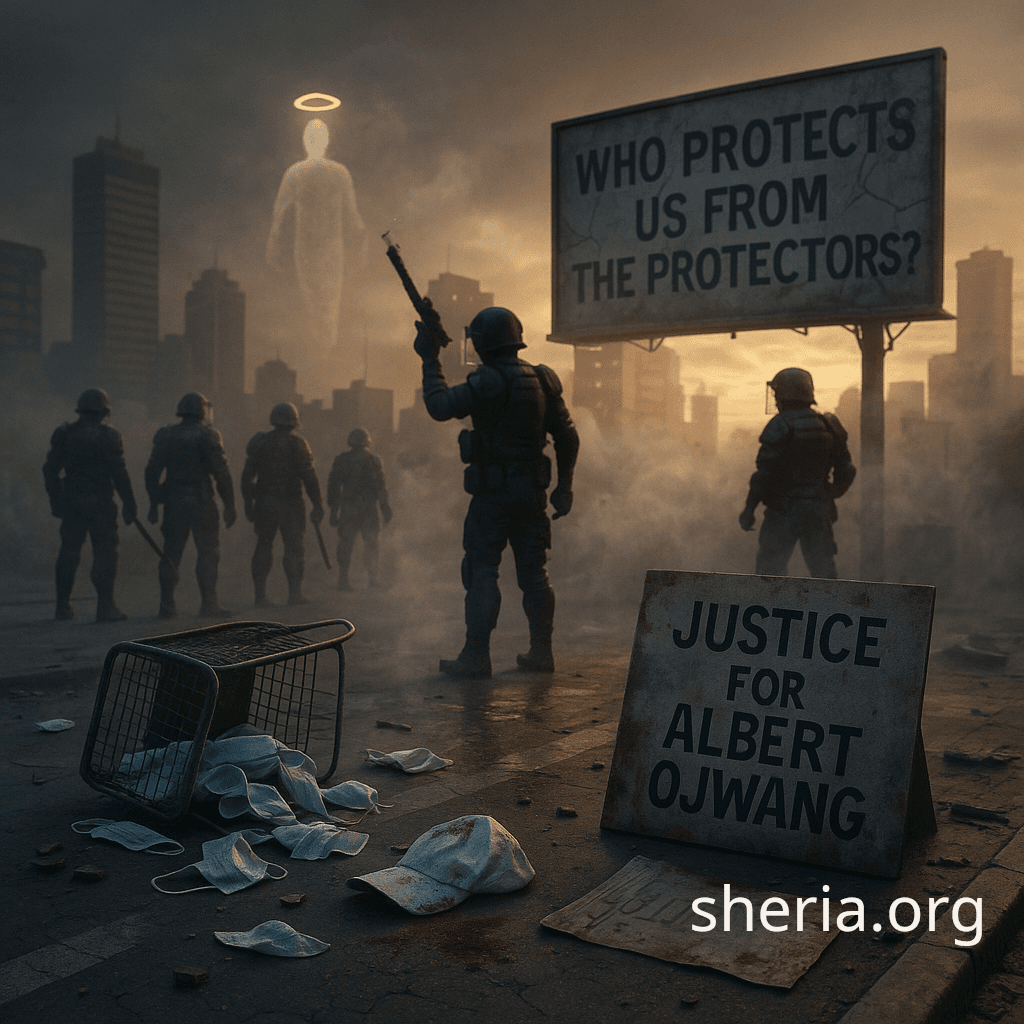
On the streets of Nairobi this week, another tragedy unfolded. During peaceful demonstrations demanding justice for the death of Albert Ojwang in police custody, a young man named Eli Joshua, a street vendor selling masks, was shot in the head by a police officer — unprovoked. He now lies in critical condition in hospital.
Sadly, this is not an isolated event. Kenyans are increasingly asking: What does the law actually say about police use of force during public protests? Are these shootings legal?
At Sheria AI, we believe that legal knowledge is power — especially when public rights are threatened. Here is what the Kenyan legal framework says — and how these events clearly violate it.
⚖️ What Is the Right to Protest in Kenya?
Constitution of Kenya (2010), Article 37 guarantees:
“Every person has the right, peaceably and unarmed, to assemble, to demonstrate, to picket, and to present petitions to public authorities.”
✅ In short: Peaceful protest is a constitutional right.
No law — including the Public Order Act — can cancel this right.
🚔 What Are the Rules Governing Police Use of Force?
Kenya is not without clear legal rules. Here is the framework:
1️⃣ The Constitution: Article 29(c) & (d)
Guarantees freedom from violence, whether from public or private sources, and freedom from:
“Torture in any manner, whether physical or psychological; and from cruel, inhuman or degrading treatment.”
2️⃣ National Police Service Act, Section 61
(Use of force and firearms)
- Use of force must be proportional, only when absolutely necessary.
- Firearms may only be used in extreme cases:
- to save lives,
- to prevent grievous bodily harm,
- or as a last resort.
Section 61(5): Intentional lethal force shall not be used unless strictly unavoidable in order to protect life.
✅ In the case of Eli Joshua, a vendor not posing any threat, lethal force is clearly unlawful.
3️⃣ Public Order Act (Cap. 56)
- Requires notification of public meetings, but does not criminalize peaceful protests.
- Does not give police the power to disperse peaceful assemblies violently.
- Police must facilitate, not frustrate, peaceful protests.
4️⃣ International Human Rights Law (binding on Kenya)
Under:
- UN Basic Principles on the Use of Force and Firearms
- African Charter on Human and Peoples' Rights
Kenya is bound to:
✅ Respect freedom of assembly
✅ Ensure strict necessity and proportionality when using force
✅ Investigate every death caused by police
🚨 How the Shooting of the mask vendor Violates the Law
- Legal RuleStatus in This CaseRight to peaceful protest (Art. 37)-Violated
- Prohibition of excessive force (Art. 29 & NPS Act)-Violated
- Guidelines on firearm use (NPS Act, Section 61)-Violated
- Duty to protect life-Violated
Shooting an unarmed vendor — without provocation — during a protest, amounts to:
✅ Excessive force
✅ Potential extrajudicial execution
✅ A grave violation of both Kenyan and international law
🛡️ Your Rights During Protests
As a citizen:
- You have the right to peacefully assemble and express yourself.
- Police must not use force unless absolutely necessary.
- You cannot be arrested or harmed for protesting peacefully.
- If injured, you have the right to file for:
- Compensation
- Criminal prosecution of officers
- Independent investigation (via IPOA)
📣 Conclusion: Legal Power Is People Power
Police violence at protests is illegal — and every Kenyan must know this.
The shooting of the mask seller is not only a human tragedy — it is a clear legal violation that demands:
✅ Independent investigation
✅ Prosecution of the responsible officer
✅ Systemic reform of police conduct during assemblies
At Sheria AI, we are committed to helping Kenyans:
- Know your rights
- Navigate the legal system
- Demand justice
Put this knowledge to work with Sheria AI
Research case law, manage your matters, and draft documents — powered by Kenyan legal AI.